PariPassu: Rastreador and CliCQ
Product Designer (team of 2 designers)
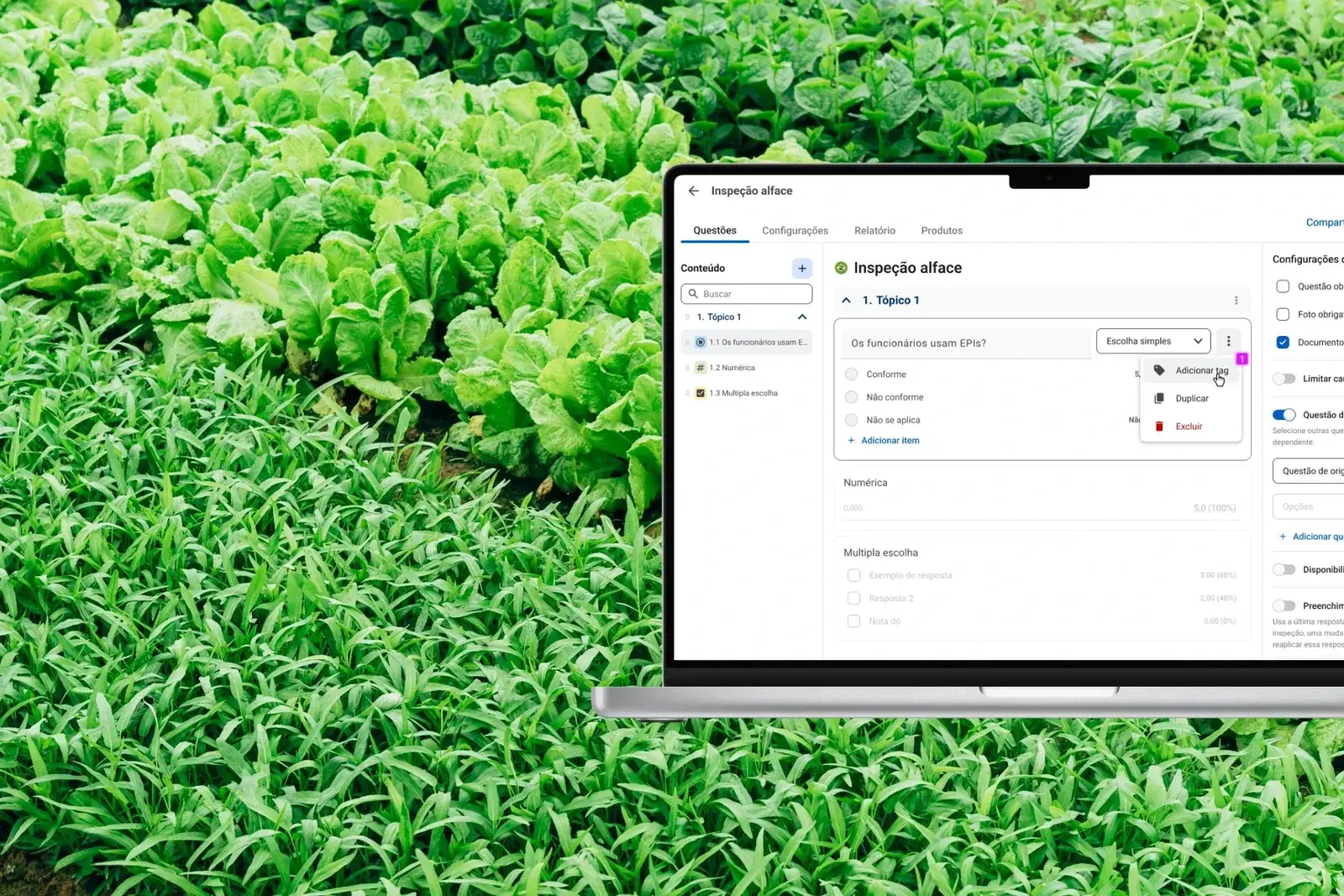
PariPassu is an agtech/foodtech connecting the food supply chain from rural producers to retail. I worked as one of the two designers at the company (~100 people) on key features across two products: Rastreador (purchase/sale traceability with ERP integration for TOTVS and Sankhya) and CliCQ (quality inspections with a conditional workflow builder, customizable forms, and mobile app). I contributed components to the existing design system and helped maintain it collaboratively. Clients include Coca-Cola LatAm operations.
2
products (Rastreador + CliCQ)
2
designers, collaborative work
ERP
integrations (TOTVS, Sankhya)
- Two products, collaborative design work
- Contributions to existing design system
- ERP integrations (TOTVS, Sankhya) and workflow builder
Editorial Content
This longform case study is currently maintained in Portuguese.
The shared interface around this page is localized, but the narrative case study content still follows its Portuguese source version.
Strategic Context
Scope: Designer at a ~100-person foodtech/agtech, working as one of two product designers on the team. Responsible for key features across two products: Rastreador (ERP + traceability) and CliCQ (quality inspection + workflow builder).
Decision authority: End-to-end UX/UI on both products, with discovery alongside industry operators, prioritization with PM/CEO, and continuous contribution to the existing design system. I worked in pair with the other designer to align patterns across Rastreador and CliCQ.
Timeline: 6 months (Jun 2025 - Nov 2025), shipping critical features across Rastreador and CliCQ while contributing to the existing DS.
Structural outcome: Contributed 10 new components to the existing DS, standardized handoff between the two products, and implemented a Figma + Make + MCP pipeline that reduced spec rework and accelerated dev sync.
The Ecosystem
PariPassu sits at the intersection of ag-tech and food-tech: traceability and food compliance. Two distinct products: Tracer (food chain traceability) and CliCQ (audits and compliance), each serving different personas: field operators and quality coordinators.
A DS was already in place when I joined, but was misaligned across the two products, which had grown independently for years. ~40% of sprint time went into repetitive visual specs that could have been standardized.
Two products, zero design system. 40% of sprint time on repetitive visual specs.
Design System: Ownership & Adoption
The design system was already in place when I joined. My work was to manage its evolution alongside the other designer, contribute 10 new components, and standardize handoff between Tracer and CliCQ.
Collaborative adoption: Started with high-frequency components (inputs, buttons, tables) with usage docs and "when NOT to use" guidance. Weekly pairing with each dev to align real usage and tune tokens.
Handoff automation: Built a Figma → Make → MCP pipeline: when a component is published, specs are extracted automatically and devs are notified in Slack with colors, sizes, variants, and a direct link. Reduced handoff friction without requiring a DS rebuild.
Month 1: 45% reuse. Month 4: 82%. Handoff: ~4h → ~2.5h per screen (30 tickets).
Tracer: File Import
Import was the biggest friction point. Operators register hundreds of movements daily; manual entry was impossible. I interviewed 4 operators and found each had a different spreadsheet format.
Critical decision: Manual column mapping over auto-detect. The engineering lead wanted automation. I argued: mismatching a 'Batch' field can trigger a product recall. Accuracy beats speed when errors have regulatory consequences.
3-step flow: Upload → Column mapping (required fields marked) → Confirmation. Each step independently saveable.
Tracer: Purchases & ERP Sync
The Purchases screen shows food-chain complexity. I defended: 'Sync pending' status with different colors per ERP (TOTVS vs. Sankhya). The PM wanted a generic 'Pending' tag.
Support logs: 3 of the top 5 tickets were 'my purchase didn't sync' with no context on which system failed. Visual tags let operators identify the failing system in 2 seconds.
The product mapping modal solves another pain: 'Banana nanica - 1Kg' in Tracer vs. numeric codes in the ERP. Visual mapping with dropdowns ensures correct sync.
CliCQ: Visual Workflow Builder
The hardest challenge. Non-technical food-industry users needed to build conditional logic: 'If inspection score < 70%, alert manager AND trigger detailed inspection.'
First attempt (failed): Sequential form with text conditions. Tested with 3 quality managers; none completed a branching flow without help. Their mental model was visual, not textual.
Second attempt (succeeded): Canvas with 3 draggable block types connected by arrows. Benchmarked against eVisit and Zapier. Same 3 managers: all completed a branching flow in under 5 minutes, no help needed.
Form Block (blue): which form, owner, notification, deadline. Condition Block (red): score ranges, classifications, per-question rules. Result Block (green): approve, reject, or chain another form.
Sequential form: 0/3 completed. Visual canvas: 3/3 in under 5 min.
CliCQ: Forms & Inspections
Form builder with 7 question types, each with 3 states. Customizable inspection reports: PDF layout, photo grouping, logo, email settings per recipient language.
Mobile inspection has two modules: - Product: QR scan → Form → Supplier → Confirm → Inspect - Process: Select Form → Select Evaluator → Inspect
Separating them came from field observation (I visited 2 distributors with inspectors). Product flow starts with physical scan. Process flow starts with person selection. Mixing caused errors.
What the research revealed
“Cada agroindústria usava layouts de coluna diferentes nos seus relatórios de rastreabilidade.”
Insight: Auto-detecção de colunas causaria erros de mapeamento, e erros nesse contexto têm impacto regulatório.
Decision: Optamos por mapeamento manual com validação visual. Mais lento, mas eliminava risco regulatório.
Impact beyond the screen
Como uma das duas designers de uma foodtech de ~100 pessoas, trabalhei em colaboração com o time de engenharia e com a outra designer para contribuir com features em dois produtos e para somar componentes ao design system já existente. O aprendizado mais forte foi sobre adoção orgânica: o padrão só vira referência quando outros designers e devs começam a rejeitar pedidos fora dele, sem ninguém precisar impor.
Let's Work Together
Interested in working together?
I design product experiences for millions of users. With 7+ years across startups, scale-ups, and companies worldwide, I'm passionate about building delightful, accessible interfaces that drive real impact.